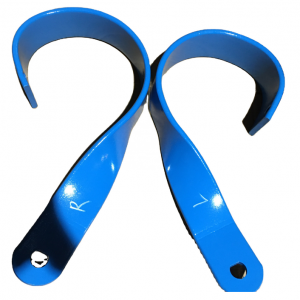
High-strength series of tillage knives
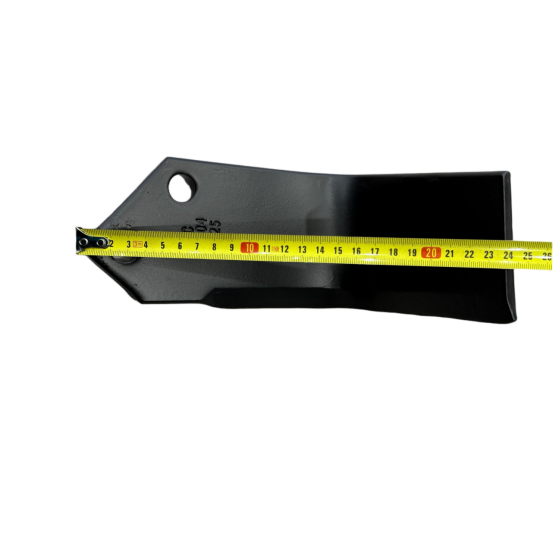
The land reclamation blades are mainly available in two structural forms: C-type and L-type. Both are integrally formed using a forging process, ensuring a dense, sand-free internal metal structure and extremely high impact resistance and toughness. The blade consists of two parts: the handle and the blade head. The handle has precision-machined fixing holes to ensure stable installation with the blade shaft. The blade head includes a tangential cutting edge and a side cutting edge, with the edges undergoing secondary strengthening and polishing, resulting in a sharp and wear-resistant blade.
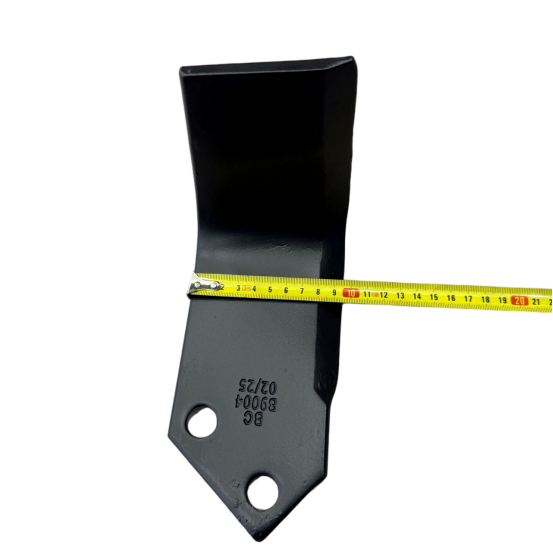
Scientific Bending Angle: The blade head consists of a tangential cutting edge and a side-cutting edge, designed with a specific arc shape. The bending arc of some patented products is precisely calculated (e.g., 119.7°-120°), optimizing the soil penetration angle and maintaining good tillage depth even after wear. It features a "self-sharpening" function, becoming sharper with use and significantly reducing cutting resistance.
High-Efficiency Cutting Combination: Equipped with both tangential and side-cutting edges, the dual-cutting design effectively cuts grass roots and vegetation, preventing tangling, increasing soil breakup, and ensuring a smooth and loose surface after tillage.
Precise fixing: The tool holder is equipped with one or more high-precision fixing holes to ensure a tight fit with the tool holder, prevent shaking and displacement during operation, and improve the stability of the whole machine.
High-strength alloy steel: The main body uses high-elasticity, high-toughness alloy steels such as 60Si2Mn and 28MnSiB as the base material, ensuring that the blade is not easily broken under high torque impact.
Digital heat treatment: Quenching and tempering are performed through a fully automated controlled atmosphere heat treatment production line, precisely controlling the product hardness between HRC 42 and 48. This hardness range balances wear resistance and toughness, avoiding the defects of being "too hard and brittle, too soft and wear-prone."
This tillage blade is highly versatile and compatible with most brands of horizontal rotary tillers, vertical ditchers, and afforestation machinery on the market. It is widely applicable to dryland farming in plains, paddy field slurrying, orchard ditching and fertilization, and layered cutting and spreading operations in camellia oleifera forests. In compacted wasteland or heavy clay soil environments, using this tillage blade reduces power consumption, saves energy compared to traditional blades, and effectively solves the problem of soil compaction, making it an ideal choice for improving agricultural production efficiency and reducing maintenance costs.