

Agricultural machinery parts: rotary tiller blades, thickened, hardened, wear-resistant, and bend-resistant.
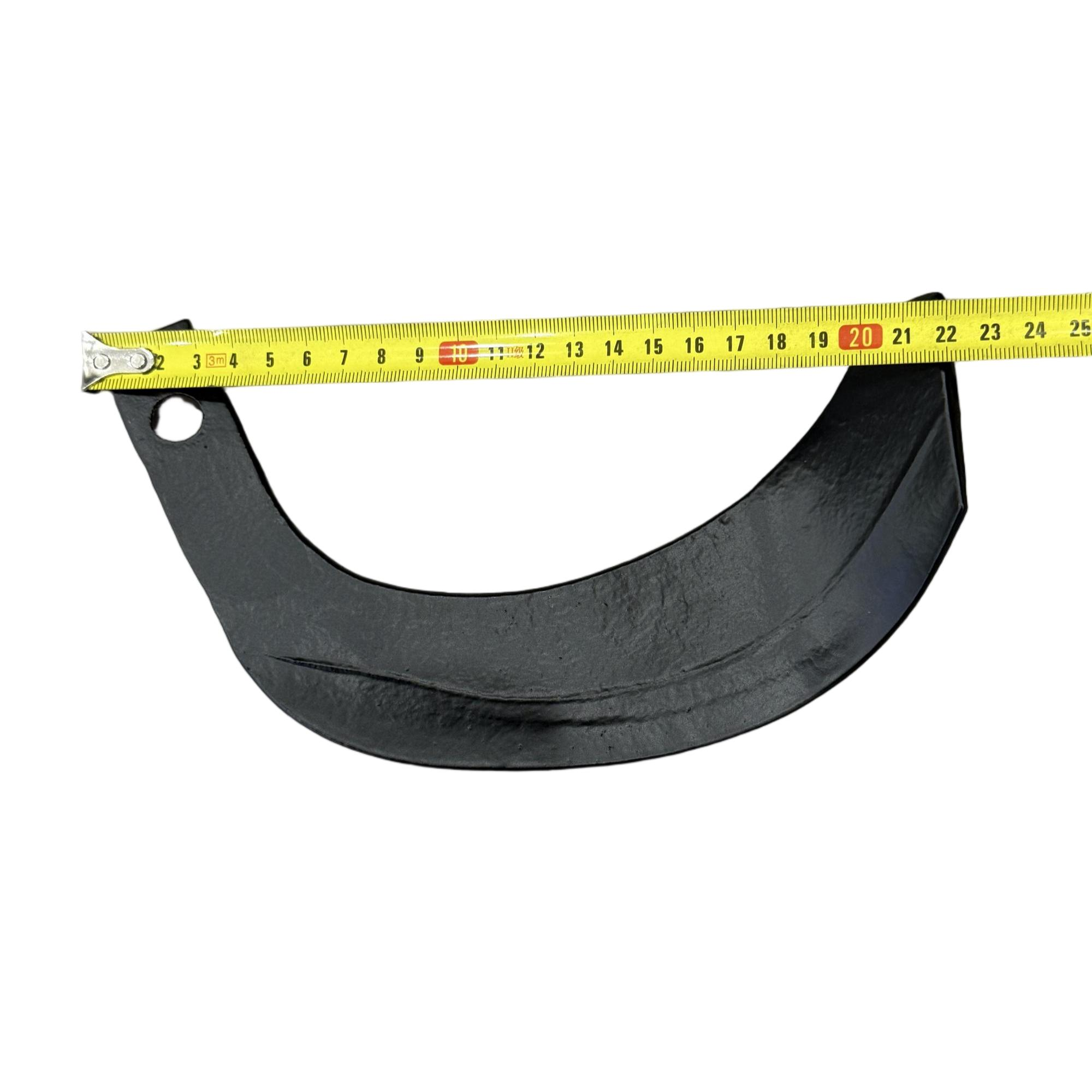
Rotary tillage blades are the core, easily worn components of a rotary tiller. Connected to the tractor's power take-off shaft, they rotate at high speed to cut the soil, achieving integrated operations of soil breaking, stubble removal, and land leveling. As the most consumed auxiliary component in land preparation machinery, its quality directly determines the efficiency and cost of farmland operations.
This series of rotary tillers uses high-strength alloy steel (such as 60Si2Mn) as the base material and is manufactured through die forging to ensure high blade density and no hidden damage. Addressing the characteristics of soil abrasion, we employ an advanced heat treatment process: after overall salt bath quenching, it undergoes tempering at a specific temperature, achieving a blade edge hardness of 55-60 HRC, while the handle maintains a toughness of approximately 45 HRC, forming a "hard on the outside, tough on the inside" dual-hardness structure that is both wear-resistant and breakage-resistant.
Wear-resistant coating technology: Targeting the rapid wear in sandy soils, an optional plasma-welded wear-resistant layer is available. A 1.5-2mm thick alloy coating is fused onto the cutting edge, achieving a hardness of 58-65 HRC, extending service life by 3-5 times compared to ordinary 65Mn steel blades.
Anti-tangling design: Optimized blade bending angle and crescent-shaped arc, combined with a smooth transition section, effectively solves the problem of straw entanglement in paddy fields or areas with multiple straw piles, reducing tractor load.
Self-sharpening function: The differentiated wear rate of the bimetallic layer ensures that the blade remains sharp throughout use, significantly reducing tillage resistance and saving fuel consumption.
It is suitable for rotary tillage in dry fields, slurry removal in paddy fields, and straw return to the field. It performs well in rice-wheat and rice-oilseed rotation areas and in fields with high stubble retention, effectively chopping up the stubble and burying it in the soil, creating a good seedbed for subsequent sowing.


